
This is fictional.
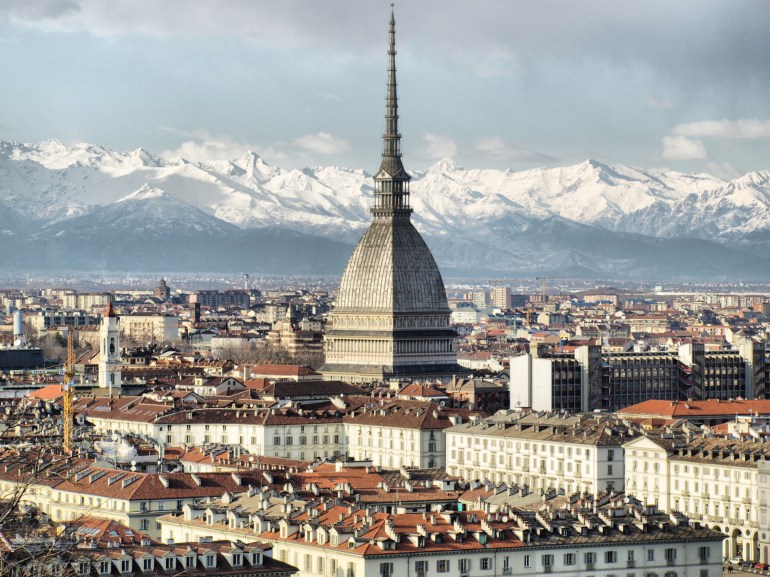
The first time I saw the shroud, the church was empty. I thought that there was more to see of the architecture, than the shroud, which looked like a bit of old rag, set in its glass case that was subsequently secured within its cage. It was hard to see it clearly. More impressive was the building above. I stared up at the crisscross of light at the top of the tower above, where windows set at angles, forced the light to strike in layers so that it looked like a classical painting of the heavens above. It was 1984.
The second time was 2005. There was Easy Jet and Ryanair, and there were so many more tourists. The first time the journey had been complicated. I had gone to visit my friend, Peter. I had a holiday romance with Mario, and we both pretended to be incredibly sad at the end and cried. We were genuine enough and made ourselves believe that it was a great loss. The first time, the journey was from the early hours of the morning until late at night. Instead of being direct from Bristol to Turin, the nearest flight had been from London to Milan. I arrived in Milan at nine at night. A bus took us to the awe-inspiring architecture of the thirties central station, quasi-Egyptian, architecture of Benito Mussolini. The streets were dark. At that time, Italy was a poorer country than it had become by the 2000s, and could not afford to light its streets properly. I took the two-hour train journey from Milan arriving in Turin at midnight, meeting a tired and slightly irritable Peter. We walked along the wide Via Cernaia to his garret studio. It was freezing, as we walked beneath the massive stone arcades above the pavements, and everywhere was closed. We slept together, both on our sides, in the narrow bed, until I was invited to Mario’s bed the following night.
***
The second time, the journey was easy. We took the bus up to Bristol International, and two hours later the plane was descending, as we crossed the hollow, stone valleys and white peaks of the Alps. ‘The shroud is the most incredible thing in Turin,’ I said, eager to tell him. ‘There isn’t really anything else to see as far as I’m concerned. It’s not the shroud that’s amazing. It’s the architecture that it’s set in. You’ve just go to see it.’
‘But I want to see the Fiat factory.’
We had told our friends that the flights had cost us eight pounds each. The airport tax had been ten pounds each way, and the busses from the airports to the city centre amounted to a further twenty pounds, but we were keeping quiet about that chunk of the finances. We had one night planned in Turin before we were to go on to see our friends at their holiday villa fifty or so miles away in the hills towards Genoa on the Mediterranean. Anthony wanted to see the Fiat factory and the road testing circuit on its roof in the suburb of the city. He had booked a place at midday. Then we were collecting our hire car to drive to our friends. We had one night in a hotel.
We booked into the hotel in the late afternoon. ‘I can’t wait to see the shroud,’ I said. ‘There’ll be just enough time.’
We went to a little gay bar in the evening. Il Triangolo Roso. It was still the same. The same fruit machine, the dance floor in the same place. I commented on the fact that I was twenty years older. ‘Far fewer guys are looking at me this time than when I was here in eighty-four.’
‘Oh really. Did guys look, even then?’ Anthony dead-panned.
In the morning we took our time. We went for breakfast in a cafe with tiny, delicate profiteroles, shaped like bears with a head and a larger belly and sugar decorations for features. ‘If we get to the shroud at ten, then we can get the bus at eleven to the factory. As we left the cafe, I said: ‘My goodness there are a lot of people. There are so many more tourists than there used to be. When I was there in eighty-four, there was no one else here. I was just about the only foreigner. There were a few French because we’re not far from the border, but Paul and I were the only Englishmen. Certainly, it was considered as being an industrial city. It was Italy’s answer to Birmingham.’
We arrived at the church in which the shroud was kept. There was a line of people down the street. ‘What on earth?’ I said. ‘No, that can’t be for the shroud. It must be for something else next door.’ I was in denial of the obvious reality, and I insisted on going up to the front of the queue.
‘No, I think that really is the queue for the shroud,’ Anthony said.
I started to realise that he was right. Cheap flights had changed cities. The residents of one city were visiting the residents of another city, and the residents of that first city were being visited by those of another. Foreignness was less foreign than it used to be.
’We can maybe go a little later in the afternoon to the Fiat factory.’
‘But we have to get the car, and I’ve booked the factory. I can’t miss the factory. It’s an absolute classic.’
‘So’s the shroud.’
‘But you could have booked the shroud, then we’d have had enough time. You could have planned ahead. I don’t want to miss the factory, just because you chose not to think ahead.’
The result was that the shroud was not to be seen, not this time, but then it would never have been the same in the company of such a multitude of other tourists, so I told myself.
 Ben Davidson Writer