

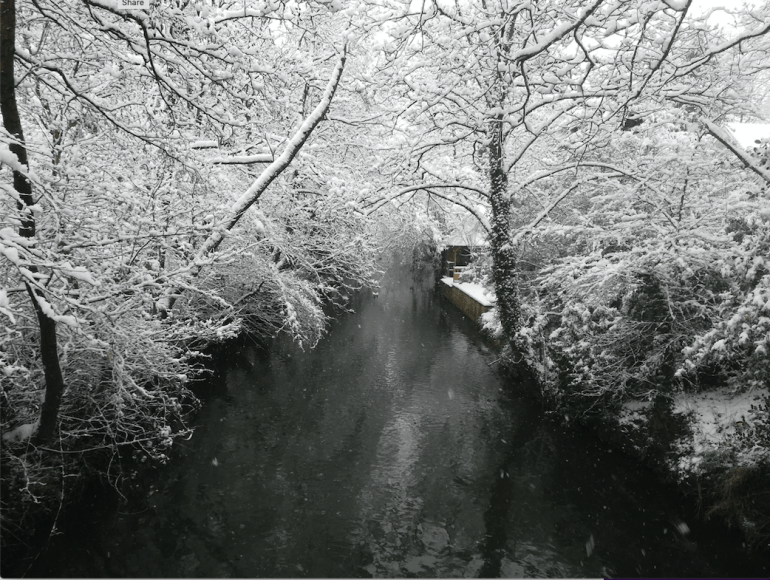
His mother said that when she was a child, ten feet of snow fell more than once. They had been stuck for two weeks, unable to leave the farm. Her father had gone up to the moors to get the sheep down but had failed to save them all. Some would freeze to death every few years, buried in a drift where they had sought shelter beside a wall. Ed’s father teased his mother, saying that she was exaggerating wildly and that there was never more than six inches of snow, but she was insistent and brought out the photos. She was accurate. The snow had been so deep that the tractor in the yard had turned to a white mound. The drifts went up as far as the gutters on one side of the barn, and the track up from the main road, when cleared by the snow plough, was a canyon with walls, far above head height.
Ed waited throughout each winter, watching every forecast, on the lookout for the harkening signs of the approach of colder weather. The fact was that, although the English winter was rarely icily cold, it was never warm enough to be classified as spring or autumn. In short, it was bitter and unpleasant enough. Damp and wet. The snow of Christmas cards was almost a figment of fantasy, and on the occasions when it did settle every few years, its novelty had a major impact on the consciousness of the people. There was a feeling of being transported to a different place, a colder place within the continent to the east, far away from the warming, maritime Atlantic effect. Each time the forecasters said that there was going to be a cold snap, he would become vigilant. He watched four or five times a day, and whenever he had a chance that he would look at the weather maps on the Internet, the masses of cold air coming down from the Arctic. He taught himself to read the synoptic charts. He had bookmarked his favourite sites and would cast a keen eye for signs of a developing buckle of colder air tipping southwards.
It was January. It had been mild and wet with westerly winds bringing rain and drizzle interminably throughout Christmas and into the New Year. The forecaster was saying that all of that was going to end. It was definitely going to snow. There was a dense mass of air poised over Scandinavia, that was growing and about to be displaced south-westwards towards Western Europe. It would soon engulf the whole of Britain, Ireland and France. Even Spain.
He watched the forecast every day for five days, keeping an eye on the developing situation.
The cold air arrived, and it froze. The ice was thick on everything as ponds, lakes and smaller rivers froze over. But it remained dry for a week. Clear blue skies, high like a dome. There was a white coating of frost on everything in the mornings. Then a pulse of warmer air was predicted to nudge in from the Atlantic to the south, exactly what was needed to create snow, as the warm mass hit the cold. Ed became restless. The snow was destined to be a spectacular fall. There were weather warnings for deep snow, blizzards that could continue for two days or more. It was likely to equal the drama of his mother’s childhood.
In the afternoon, at school he looked out the window, searching for the thickening clouds, picturing the sight, drifts up to the eaves. That night, the cloud continued to thicken slowly. He watched the forecast in the morning. But the weatherman had changed his mind. He was saying that it looked as though there would be snow across the north of England, from a line across the Midlands, but to the south, where Ed lived, there would be rain. He was desperately disappointed, almost annoyed at the forecaster’s change of prediction. There had been such certainty, that it seemed almost an abandonment. He found it hard to believe that the announcer was unapologetic.
Ed went to school. But during the morning, as the mild air hit the biting cold easterly, the air near to the ground remained cold, below freezing. The droplets gathered and grew, the rain became heavier and froze to the ground, the trees, pavements, roofs, lawns, cars, park railings. Icicles formed on street lights, long and dagger-like. The ice formed a harsh, cruelly severe, but ethereal, bluish layer that coated everything. On the school, the ice was streaking the brick walls that faced the very slight breeze. It was an unusual phenomenon: a storm of freezing rain.
As the children noticed the ice-storm, there was too much excitement to focus on lessons, and Ed was distracted from his work. When they left the school, it was hard to walk across the car park. Just outside the school gates, he realised that he had stepped onto a section of pavement that was too steep for his shoes to grip. He had to grab onto the school railings. Then he and his friends started to laugh at their predicament, at how the situation had hopelessly reduced their ability to move from place to place. One of his friends had walked too far from the railings, and failing to get a hold of them, had no choice but to let himself fall to the ground where he slid to the foot of the slope.
A teacher’s car lost its purchase on the glistening road surface, just as it left the gates, slid slowly down the road and glided into a wall, the back bumper crumpling slowly with a crunching, grinding sound. It ended with a screech of metal and a yell from Mr Holden, the deputy-head, as he stepped from his car. Ed was laughing, along with other children. It was uncontrollable, painful laughter.
The walk home from school took more than an hour to cover the mile that was normally fifteen minutes. Several times, he slipped over, once hard on his bottom, with the shock running up through his spine, taking his breath away. The icicles were growing, so that by the time he was home there were foot-long, cathedral organ pipes hanging from the gutters. As he approached the house, he saw his mother at the window. She gave him a faint, absent-minded wave, and continued to stare at the icy spectacle. He concentrated on walking to the door, avoiding the path, which was glassy with ice. The camber of the asphalt made it treacherous. He used the lawn’s rougher surface to make it from the gate to the house. Even so, he slipped, as he had done many times that day. The steps up to the house were hard to walk on until he was able to put a hand in the letterbox and steady himself. Once inside, he went to his mother. He wanted to tell her the details his walk home, about the out of control cars and the comedy of his schoolmates sliding on the steep section of pavement outside the school.
He went into the room where she was standing, her palms on the windowsill. There was something as quiet, and restful as snow falling about her. Since he had entered the garden – as he had been struggling to the house, completing the walk, every inch of which had been hazardous – her expression had remained unchanged. She was still looking from the window, eyes wide with astonishment. Unusually, she barely seemed to notice his presence. ‘They sent us home early,’ he said, ‘but it took me ages to get home. It’s taken an hour and a quarter, ‘thinking that she might be roused into conversation.
She did not turn. He could see that she was transfixed, in thrall to the sight displayed before her, the rain that had been falling all day, thickening the coating, the boughs of trees, starting to sag under the weight of ice. ‘This is absolutely incredible,’ she said. ‘It’s very, very beautiful, but I’m not sure quite whether it isn’t really very spooky and frightening as well. I have never seen anything like it ever before.’
 Ben Davidson Writer